Composite fillings repair


If cavities and small fractures are not treated, they can cause defects in teeth that worsen over time. In the past, metal restorations were used to address this issue, but they often resulted in discolored and strained teeth due to the pressure exerted by the metal. Nowadays, tooth-colored composites offer a great alternative for restoring these defects. These composites blend seamlessly with the natural tooth structure and can be applied in thinner layers compared to metal restorations, allowing for the preservation of more of the natural tooth.

Composites play important roles in both functionality and aesthetics.


Composites play a dual role in both functionality and aesthetics, often simultaneously. For instance, if there is a cavity on the front of a tooth near the gum line, it may be visible when you smile. However, by carefully removing the discolored area and preventing further decay, the tooth's healthy mineral surfaces are preserved. Additionally, by using a composite material that matches the color of the tooth, the tooth's appearance is enhanced.

Composites are made up of a mixture of liquid resin and finely ground glass particles. Once molded onto the prepared tooth structure, a blue light is applied directly to the composite, causing it to harden within seconds. The composite is then shaped and polished to achieve a high shine that mimics the natural beauty of enamel. This results in an invisible restoration that is both strong and smooth, while also being conservative in its approach.
If it's been six months since your last dental checkup, then it's time to contact our practice and schedule your next appointment!

Be confident and smile


Illustration of toothbrush cleaning upper teeth, dental hygiene demonstration for general dentistry practice.

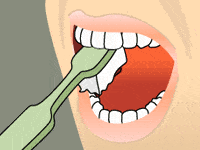
Brushing: Step 1

Place your toothbrush at a 45-degree angle to your gum.
Illustration of tongue scraping technique showing green scraper removing bacteria from tongue surface.

Brushing: Step 2

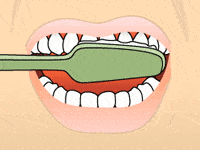
Brush gently in a circular motion.
Toothbrush cleaning upper teeth inside open mouth with white teeth visible and red lips.

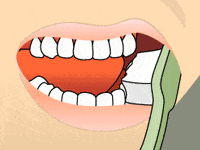
Brushing: Step 3

Brush the outer, inner, and chewing surfaces of each tooth.
Dentist applying white dental material to patient's open mouth during treatment procedure.

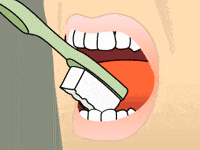
Brushing: Step 4

Use the tip of your brush for the inner surface of your front teeth.
We warmly invite you to reach out to us or pay a visit to our office today, as we are more than delighted to provide you with comprehensive information about the remarkable benefits of composite bonding and how it can truly transform and enhance your beautiful smile. Our team of highly skilled professionals is eagerly anticipating your response, as we are genuinely excited to assist you in achieving the smile of your dreams. Don't hesitate to contact us at your earliest convenience, as we are here to answer any questions you may have and guide you through the process with utmost care and expertise. We look forward to hearing from you soon!

Flossing Instructions


Two hands making peace signs with green line connecting them against gray background.

Flossing: Step 1

Wind about 18 inches of floss around your fingers as shown. Most of it should be wrapped around one finger, and the other finger takes it up as the floss is used.
Two hands demonstrating proper holding position for dental floss against gray background.

Flossing: Step 2

Use your thumbs and forefingers to guide about one inch of floss between your teeth.
Illustrated close-up of open mouth showing teeth and tongue during dental examination or treatment procedure.

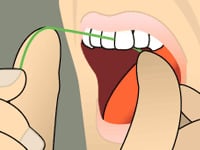
Flossing: Step 3

Holding the floss tightly, gently saw it between your teeth. Then curve the floss into a C-shape against one tooth and gently slide it beneath your gums.
Illustration of open mouth showing tongue and oral cavity during dental examination or procedure.

Flossing: Step 4

Slide the floss up and down, repeating for each tooth.